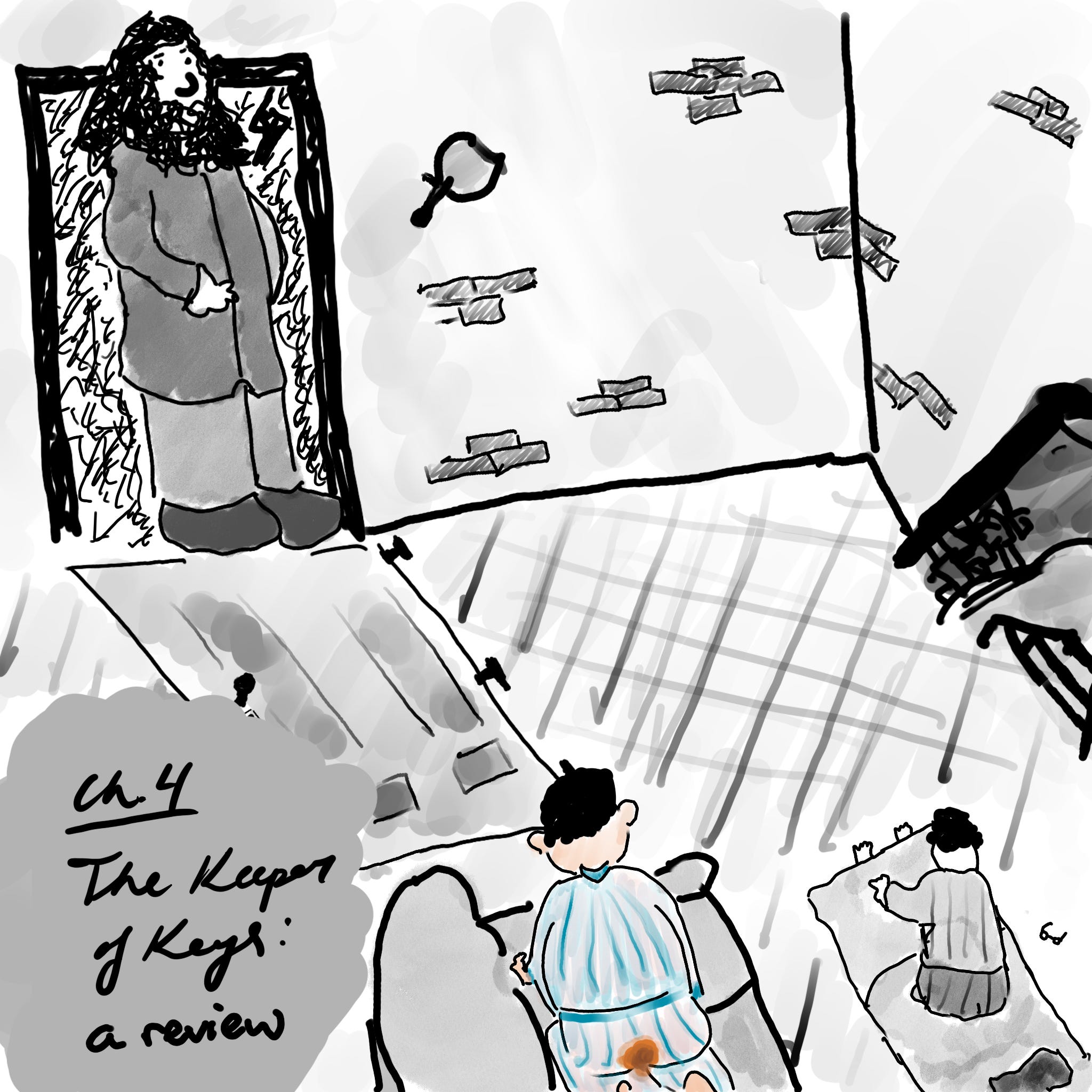
The Keeper of Keys, reviewed.
Reviewing the fourth chapter of Harry Potter and the Philosopher's Stone

Reader discretion is advised for unhinged stream of consciousness reaction to chapter.
Summary
The fourth chapter opens with the introduction of Hagrid, the keeper of keys and grounds at Hogwarts, whose job title is eponymous to the chapter’s title. Because in late-stage capitalism, our value-generating function in an exploitative market economic system is all we need to know about a person.
Much of this chapter is spent with Harry being punched in the face by facts about his parents (murdered), the Wizarding World (patriarchy), the concept of a Muggle (which feels like a slur considering it’s spelled with two g’s in the middle), and Voldemort - the guy who murdered Harry’s parents and whose name wizards and witches fear to say aloud (dumb).
The fourth chapter ends with Harry struggling to accept that he is a wizard (the self-doubt doesn’t last long), the Dursleys resisting Harry going to Hogwarts (with limited success), and Hagrid conjuring a pig’s tail on Dudley (fat-shaming) in a fit of cruel, misdirected anger in response to Uncle Vernon characterizing Dumbledore, Hogwarts’ headmaster, as a crack-pot. A claim that was legitimized, not debunked, from this reader’s perspective over the course of the series.
Reaction
They say good writers don’t need adverbs to effectively describe the way a character is saying something.
I described that adage pretty smartly.
So when Rowling starts the fourth chapter by describing Dudley Dursley asking a question “stupidly”, she is being pretty dumb and lazy.
But maybe she isn’t being dumb and lazy. Maybe Rowling is doing it intentionally.
Maybe it’s more about the story and the world than about the characters and their humanity being realized.
Maybe everyone in JK Rowling’s Wizarding World is a tool or simply a means to an end in telling the story she wants told.
Maybe it doesn’t matter what Harry Potter’s opinions are about Fruit of the Loom-brand underwear or Israel’s genocide of Palestinians or the Arab-supremacist genocide of black people in Sudan.
Maybe that dimensionality or complexity beyond the character’s narrative function does not matter.
Maybe it actually makes the story harder to tell if we’re confronted, or inundated, with a character’s paradoxes, dissonances, and humanity.
Maybe genuine confrontation with a protagonist’s moral fragility or being made to feel compassion for an antagonist calls into question too many things about what we believe and how we see ourselves.
Maybe that form of storytelling is too uncomfortable because it shows us how untenable and amorphous our concepts of justice are and how empty our indictments of injustice are.
Maybe this is the crux of tribalism and why it is so hard to see “us” in “them”.
Maybe we prefer to “other” them.
Maybe it helps us justify why we are not them and why they are there and why we are here.
Maybe it’s easier to create and digest concepts of “us” and “them” than considering if there is even an “i” that exists in relation to anyone or anything.
Maybe we are still clinging on to comfort and pleasure and ease and ego when we believe that we’ve conceded to nihilism or powerlessness.
Maybe nothingness isn’t the end, but actually the beginning.
Or maybe.
Maybe Dudley Dursley just asks stupid questions stupidly and we should shut the fuck up and Free Palestine before we have to Remember Palestine. Other stuff happened in the chapter. Mostly dialogue. I really hope this doesn’t feel like AI-slop.
Review
I’ll probably retract this statement at some point, but I think this may have been the hardest chapter for Rowling to get right in the entire series. Up until this point, it was two worlds in parallel play with pipes being laid about who Harry Potter is as a character, not his identity. But in this chapter, the two worlds were brought together to actually start the story. And I think it was done poorly.
This chapter falls apart with the manufactured rage from Hagrid “discovering” how little Harry Potter knows about the Wizarding World and himself. Hagrid should not be upset or surprised that Harry knows nothing; Dumbledore told Hagrid that Harry probably doesn’t know much. Beyond this, there was clear resistance to Harry entering the Wizarding World. Harry not knowing anything about the Wizarding World and himself is the plot device used to bring the two worlds together to actually start the story. Hagrid’s rage was disingenuously manufactured to have that plot device carried out the way it was. It undermined Hagrid’s relationship with Dumbledore, Hagrid’s value as a reliable interlocutor, and it called into question how Dumbledore is being presented as intelligent, beneficent, and powerful.